FAO Report on Global Fish Fraud and Solutions
Seafood is one of the most widely consumed sources of protein in the world. Yet, according to a new report from the Food and Agriculture Organization of the United Nations, a significant portion of the fish sold globally may not be what it claims to be. The publication highlights the widespread nature of fish fraud, the risks it poses to health and sustainability, and the advanced tools now available to detect and prevent it.
A Growing Concern in a $195 Billion Industry
The global fisheries and aquaculture sector is valued at approximately $195 billion. Despite its importance to food security and livelihoods, the industry faces a serious challenge: fraud. While there is no official global estimate of how widespread the problem is, empirical studies suggest that roughly 20 percent of seafood trade may involve some form of deception. In some contexts, mislabeling rates may reach as high as 30 percent, particularly in restaurants.
The FAO report, titled Food Fraud in the Fisheries and Aquaculture Sector, was produced through collaboration between FAO’s Fisheries and Aquaculture Division and the Joint FAO/IAEA Centre of Nuclear Techniques in Food and Agriculture. It provides one of the most comprehensive assessments to date of seafood fraud and the scientific methods available to combat it.
What Is Fish Fraud?
The report defines fish fraud as a deliberate act intended to deceive others for economic gain. This deception can take many forms and may pose risks to biodiversity, public health, and economic systems.
Fish fraud is particularly complex because of the enormous diversity within the seafood market. Globally, more than 12,000 seafood species are traded and consumed. The wide variety of species, supply chains that span multiple countries, and inconsistent regulatory definitions make the problem difficult to quantify and control.
Common Types of Fish Fraud
The FAO report categorizes seafood fraud into several major types:
- Adulteration: Adding substances to enhance appearance or weight. For example, coloring agents may be used to make tuna appear fresher.
- Counterfeit Products: Imitation seafood products made from alternative ingredients, such as starch-based compounds marketed as shrimp.
- Simulation: Packaging lower-value products like surimi to resemble premium crab meat.
- Species Substitution: Selling one species as another, such as tilapia marketed as red snapper.
- Mislabeling and Misbranding: Incorrect information about origin, sustainability claims, or expiration dates.
- Diversion: Selling legitimate products outside their intended markets.
- Overrun: Producing quantities beyond legal quotas, contributing to overfishing.
- Tampering and Theft: Manipulating packaging or stealing products for resale.
Species substitution is among the most common forms of seafood fraud. Studies cited in the report indicate that while mislabeling is relatively rare in processing plants, it is more common at the retail and restaurant levels, especially in sushi establishments.
Health and Environmental Risks
Fish fraud is not merely an economic issue. It can also pose significant risks to consumers and ecosystems.
Some seafood species carry health risks when eaten raw or improperly handled. For example, re-freezing fish increases the likelihood of bacterial growth. If consumers are unaware of a product’s true origin or storage history, they may unknowingly expose themselves to foodborne illness.
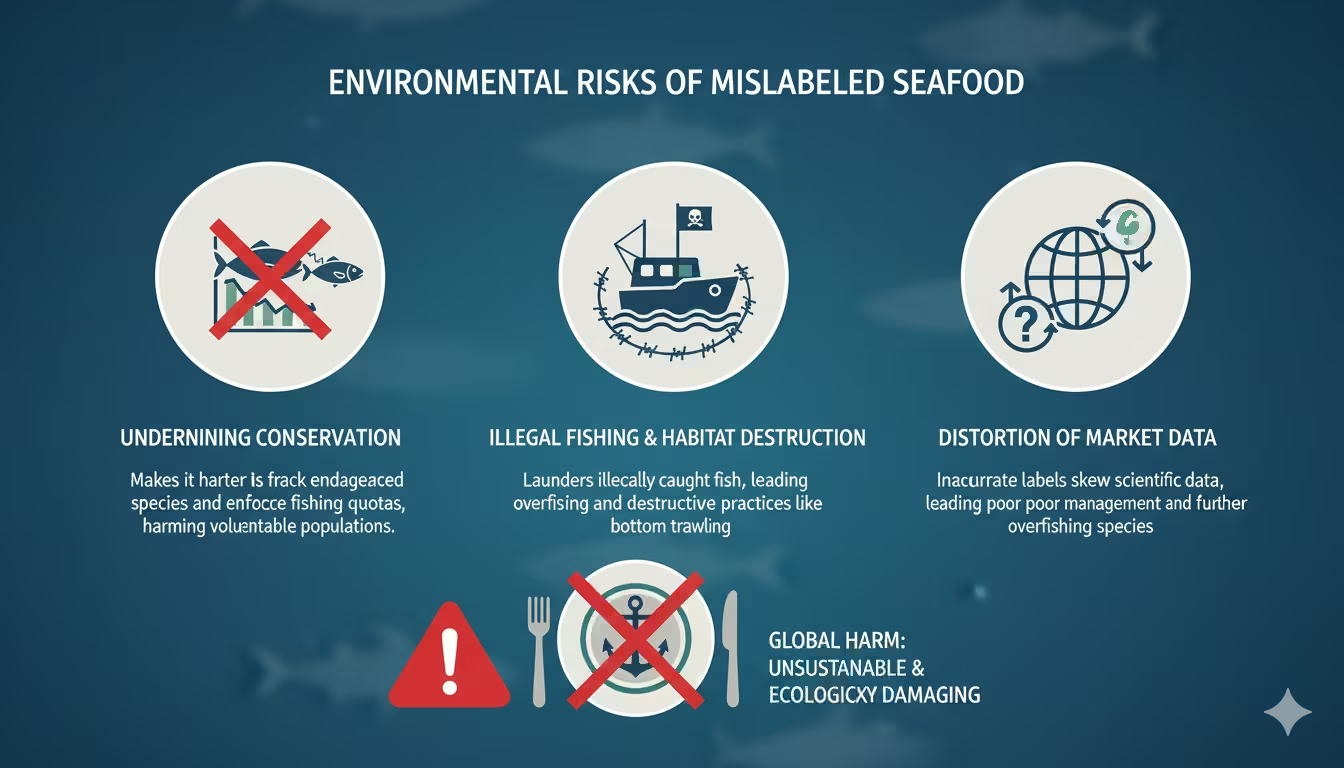
Environmental concerns are equally serious. Fraudulent labeling can mask illegal fishing practices or conceal fish caught beyond legal quotas. Misrepresenting the geographic origin of seafood may hide overexploitation of vulnerable fish stocks. When farmed fish are marketed as wild-caught, consumers lose the ability to make informed sustainability choices.
Economic incentives often drive these deceptive practices. For instance, selling farmed Atlantic salmon as wild Pacific salmon can generate nearly $10 more per kilogram. Similarly, farmed seabass labeled as locally sourced in Italy can sell for two to three times the price of identical fish from Greece or Turkey. In some cases, adding water to seafood products increases their weight and boosts profits.
The Evidence Gap
Although thousands of studies on seafood fraud have been conducted across nearly every continent, reliable baseline data on its global prevalence remain limited. The absence of standardized definitions and regulatory frameworks complicates efforts to measure the problem accurately.
In the United States, for example, some studies suggest that up to one-third of seafood products may be mislabeled. However, less than one percent of imports are routinely tested. Similar findings have emerged from research in Latin America, China, and the European Union.
This gap between the scale of consumption and the scope of testing highlights the need for stronger monitoring systems and harmonized standards.
Scientific Tools to Detect Fraud
One of the most promising aspects of the FAO report is its detailed examination of advanced scientific methods used to detect fish fraud.
Traditional visual inspection is often insufficient because many seafood products are processed, filleted, or cooked before sale. As a result, authorities increasingly rely on laboratory techniques such as:
- Enzyme-Linked Immunosorbent Assay (ELISA) to detect specific proteins.
- DNA Barcoding to identify species accurately.
- Stable Isotope Analysis to determine geographic origin.
- Nuclear Magnetic Resonance (NMR) to analyze chemical composition.
- Carbon and Nitrogen Ratio Testing to trace environmental origins.
- Portable X-Ray Fluorescence Devices for on-site screening.
- Machine-Learning Models that analyze patterns and detect anomalies.
Although these technologies are highly effective, they are not universally accessible. Many developing countries lack the resources and technical capacity to implement advanced testing systems. Expanding access to such tools is therefore a key priority.
Real-World Initiatives and Success Stories
The report highlights several initiatives aimed at reducing seafood fraud.
In Los Angeles, California, an investigation using DNA barcoding revealed varying levels of mislabeling across the supply chain. While processing plants showed low rates of fraud, grocery stores demonstrated moderate levels, and sushi restaurants exhibited particularly high rates.
A collaborative initiative involving academia, industry, and government stakeholders launched an education campaign combined with ongoing blind testing. Over a period of ten years, seafood mislabeling in the target area declined by two-thirds. This example demonstrates that coordinated efforts can produce measurable improvements.
Similar enforcement actions and testing programs have been implemented in countries such as Italy and Argentina. These efforts underscore the importance of partnerships between regulators, scientists, and the private sector.
Strengthening Regulation and Standards
The FAO report emphasizes the need for harmonized labeling requirements. Clear and consistent rules would help consumers make informed choices and reduce opportunities for fraud. The inclusion of scientific names on packaging, where feasible, would improve transparency and traceability.
Improved traceability systems are also essential. Digital tracking technologies can help monitor seafood from catch to consumer, reducing the likelihood of tampering or substitution.
International cooperation is critical in this effort. FAO is working alongside the Codex Alimentarius Commission to develop global standards that address food fraud. Through the Joint FAO/IAEA Centre, technical support is also provided to member countries seeking to strengthen laboratory testing capacity.
The Path Forward
Seafood plays a crucial role in global nutrition and food security. Ensuring its authenticity is vital not only for consumer trust but also for environmental sustainability and fair economic practices.
The FAO’s new report makes clear that fish fraud is a global issue requiring coordinated international action. While scientific tools for detection are advancing rapidly, prevention remains equally important. Stronger enforcement, better labeling standards, improved traceability systems, and active private-sector participation are essential components of a comprehensive strategy.
Ultimately, combating fish fraud protects more than consumers’ wallets. It safeguards marine ecosystems, supports responsible fisheries management, and strengthens the integrity of global food systems. With continued collaboration and innovation, meaningful progress is possible in reducing and eventually eliminating seafood fraud worldwide.



0 Comments