Some of the links below are Amazon affiliate links. As an Amazon Associate we earn from qualifying purchases, at no additional cost to you.
Optimum Nutrition Gold Standard Whey Protein is worth it if you train with weights and want a protein source without excess sugar or fat, delivering 24 g of protein per scoop from whey protein isolate. It isn’t for anyone avoiding dairy. You also get 5.5 g of naturally-occurring BCAAs and 11 g of EAAs for recovery after lifting.
| Preview | 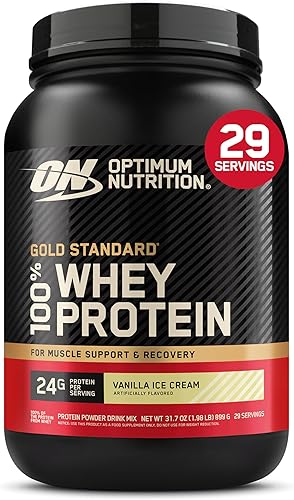 |
|---|---|
| Product | Optimum Nutrition Gold Standard Whey |
| Brand | Optimum Nutrition |
| The listing says | 24 g whey protein per scoop 5.5 g BCAAs and 11 g EAAs |
| More information | Check Latest Price on Amazon |
Good for: Lifters wanting fast-absorbing whey with minimal sugar, carbs, and fat. Not for: Anyone avoiding dairy or needing plant-based protein alternatives.
What it stakes its case on
The first thing this listing leads with is 24 g of high-quality whey protein per scoop, and it specifies that 100% of that protein comes from whey. That matters because whey digests rapidly, delivering amino acids to muscles soon after you finish training. If you’re mixing a shake right after the gym, you don’t want something that sits heavy in your stomach while your body tries to break it down. The claim here is a complete protein source that supports muscle maintenance and growth, which is exactly what someone lifting weights needs from their daily intake.
Next, the listing highlights 5.5 g of naturally-occurring BCAAs alongside 11 g of naturally occurring EAAs. These aren’t sprinkled in as extras; they arrive as part of the whey itself. BCAAs include leucine, isoleucine, and valine, which the manufacturer says support post-workout recovery and strength. When you train hard, those specific amino acids do the heavy lifting in repairing muscle tissue, so getting them directly from your protein powder saves you from buying a separate supplement just to cover that gap.
The third pillar is the macronutrient profile: roughly 1 g of sugar, about 3 g of carbs per serving, and low fat. The listing explains that whey protein isolate is the primary ingredient, meaning further carbs and fat are isolated out during processing. This setup targets athletes focused on lean muscle, weight management, or body-composition goals. You aren’t drinking hidden calories when you mix this into water, which keeps your daily totals predictable.
Finally, the formula is instantized for easy mixing. The listing says it dissolves smoothly in water, milk, or smoothies using just a spoon, shaker, or blender. Nobody wants clumps stuck to the bottom of their bottle after a long workout. Taken together, these four points build a strong case for post-workout nutrition, but they only answer the recovery part of fitness. They don’t address pre-workout energy or meal replacement, so this covers one specific job very well rather than doing everything at once.
Which claims have something behind them
A lot of supplement labels throw around words like “high-quality” without showing their work, but this listing attaches real figures to most of its main promises. You get 24 g of protein per scoop, and the manufacturer states clearly that 100% of it comes from whey. That isn’t vague marketing language; it tells you exactly where the macros originate. The same goes for the 5.5 g of BCAAs and 11 g of EAAs. Because the listing calls them “naturally-occurring,” it means they’re inherent to the whey rather than added as separate powders to inflate the label.
The low-sugar and low-carb claims are backed by specific amounts too: roughly 1 g of sugar and about 3 g of carbs per serving. Those numbers let you fit this powder into a strict diet without guessing. The listing also names whey protein isolate as the primary ingredient, explaining that further carbs and fat are isolated out. That detail gives context to why the carb count stays so low. Whey protein isolate undergoes more processing than concentrate, removing most non-protein components before packaging.
Where the listing leans on words instead of figures, it talks about “great mixability” and being “trusted.” It says athletes have trusted Optimum Nutrition for 35 years, which is a timeline you can verify through the brand’s history, but trust itself isn’t a measurable spec. The instantized formula is described as dissolving smoothly with a spoon, shaker, or blender, yet no figure defines how quickly that happens. Still, the core nutritional claims rest on stated grams and named ingredients rather than empty adjectives. When a product tells you exactly how much leucine, isoleucine, and valine you’re swallowing, you don’t need to take the marketing department’s word for it.
Specifications
Here are the figures the manufacturer provides for the Vanilla Ice Cream version.
| # | What Amazon lists |
|---|---|
| 1 | 24 g High-Quality Whey Protein per Scoop – 100% of the protein from whey for a fast-absorbing, complete protein source that supports muscle maintenance and growth. |
| 2 | 5.5 g Naturally-Occurring BCAAs + 11g of naturally occurring EAAs – Delivers essential amino acids including leucine, isoleucine, and valine to support post-workout muscle recovery, muscle strength and muscle building when taken over time with regular resistance training. |
| 3 | Low Sugar, Low Carb, Low Fat — Ideal for Lean Muscle or Cutting Phases – With just ~1 g sugar, ~3 g carbs per serving, and whey protein isolate as the primary ingredient with further carbs and fat “isolated” out. It’s a high quality choice for athletes focused on lean muscle, weight management, or body-composition goals. |
| 4 | Instantized & Easy-Mix Formula (Great Mixability) – Designed to dissolve smoothly in water, milk, or smoothies with a spoon, shaker, or blender — perfect for fast post-workout shakes or convenient protein boosts. |
| 5 | Trusted Brand, Tested Quality & Versatile Use – For 35 years, athletes have trusted Optimum Nutrition to fuel their training. Gold Standard Whey is the trusted choice for gym-goers, athletes, and everyday fitness enthusiasts worldwide — use post-workout or as a protein supplement anytime. |
A plainer one: what you give up
If you step down to a simpler whey protein in this category, you’ll usually find whey protein concentrate sitting at the top of the ingredient list instead of isolate. Concentrate undergoes less filtering, which means it retains more of the natural lactose, fats, and carbohydrates found in milk. Your shakes will carry more sugar and slightly heavier macros per scoop, making it harder to stay within tight daily limits when you’re cutting or tracking body composition closely.
Simpler options also tend to skip the instantizing process. Without that step, the powder resists mixing, leaving stubborn clumps at the bottom of your shaker unless you use a blender every single time.
A plainer whey is genuinely the smarter choice for someone who blends everything into thick smoothies loaded with fruit and oats anyway. In that context, the extra carbs blend into the recipe unnoticed, and the mixing issues disappear behind the blender blades. But if you drink your protein straight with water after a workout, giving up isolate and instantization means dealing with a heavier, lumpier shake that doesn’t align with lean muscle goals.
A more capable one: what you gain
Stepping up to the next tier in sports nutrition usually means moving away from standard whey toward hydrolyzed whey proteins. Hydrolysis breaks the protein chains into smaller fragments before they even reach your stomach, speeding up absorption beyond what standard isolate delivers. For an athlete training twice a day, that turnaround between sessions can matter.
Higher-tier formulas often add digestive enzymes like protease or lactase directly into the blend. These help break down the remaining dairy components, reducing bloating or discomfort for people who tolerate plain whey poorly. You might also find added functional ingredients such as creatine, glutamine, or extra BCAA dosing beyond what occurs naturally in the milk source.
Most buyers won’t notice the difference in absorption speed unless their training schedule leaves almost no recovery window between heavy sessions. The step up is genuinely worth taking for competitive athletes who need every possible advantage in repair timing, or for individuals whose digestion rebels against standard dairy proteins. For the everyday gym-goer lifting three or four times a week, the naturally-occurring 5.5 g of BCAAs and 11 g of EAAs listed here already cover the fundamental recovery requirements without needing enzymatic assistance or pre-digested chains.

What owning it asks of you afterwards
Buying the tub is just the start. Once you open it, you’re committed to a cycle of mixing, measuring, and eventually replacing it. The listing notes this is a 2LB container, and each serving requires one scoop to deliver the promised 24 g of protein. Depending on how many shakes you drink daily, that two-pound supply won’t last forever. Someone training five days a week and taking one scoop per session will empty the tub steadily, meaning you’ll need to keep ordering refills to avoid gaps in your nutrition plan.
You also have to decide what you’re mixing it with. The manufacturer says it works in water, milk, or smoothies, using a spoon, shaker, or blender. Water keeps the macros exactly as listed, but milk adds its own carbs, fats, and sugars to the glass. If you’re strictly watching that roughly 1 g sugar and 3 g carb count per serving, switching to milk changes the math entirely. You’ll need to track whatever liquid you choose.
The listing does not state whether a scoop is included. Check before buying if you need it, because measuring by eye ruins the precision of those stated figures. You’ll need a dry place to store it so the instantized powder doesn’t clump before you even add liquid.
How much use it has to stand up to
Protein powder isn’t a machine with moving parts, but it still faces physical stress depending on your routine. If you train most days, you’re opening the lid, digging in the scoop, and sealing it back up constantly. Moisture from the air enters every time you do that. The listing emphasizes an instantized formula designed for great mixability, which relies on the powder staying dry and free-flowing. Clumping defeats the purpose of a powder meant to dissolve smoothly with just a spoon or shaker.
The 2LB size means frequent turnover if you use it daily. That’s actually good for freshness, since a massive tub sitting open for months risks degrading quality. Whey protein isolate, named here as the primary ingredient, is highly refined, but refinement doesn’t make it immune to humidity or heat.
What the listing doesn’t give you is a shelf-life guarantee once opened. Manufacturers rarely print exact expiration timelines for post-opening use, but the absence of preservatives in the highlighted features suggests you shouldn’t leave it half-empty for seasons at a time. If you only lift occasionally, say once a week, this two-pound container will sit around much longer, increasing the chance that environmental factors compromise the texture before you finish it. Regular users burn through it fast enough that staleness rarely becomes an issue.
Verdict by how hard you will use it
Lifting once or twice a week
Skip this specific 2LB tub if your workouts are truly occasional. While the 24 g of protein and low sugar profile remain excellent, infrequent use means the powder sits open longer, risking moisture exposure that ruins the instantized mixability. Look for smaller packaging if available, or save this formula for periods when your training frequency increases.
Training three to five days regularly
Buy it. This matches exactly what the listing describes: gym-goers and everyday fitness enthusiasts needing reliable post-workout recovery. The 5.5 g of naturally-occurring BCAAs and 11 g of EAAs support the kind of consistent muscle breakdown and repair that happens during a standard weekly split. You’ll move through the container at a healthy pace, keeping the whey protein isolate fresh while benefiting from the low carb and fat counts that make daily tracking simple.
Competing or training multiple times daily
Buy only if you tolerate standard dairy perfectly and don’t require added digestive enzymes. The fast-absorbing nature of 100% whey helps, but elite schedules often demand hydrolyzed versions or supplemental amino acids beyond what occurs naturally here. If you fall into this group, check whether your current regimen already covers the basics this powder provides, and look for specialized competition-grade formulas if you need rapid gastric emptying or enzymatic support.
The questions that decide it
What does the thirty-five year history actually guarantee?
The listing states athletes have trusted Optimum Nutrition for 35 years, but longevity alone doesn’t guarantee batch-to-batch consistency. What backs the quality claim here is the specific formulation: every gram of protein is derived exclusively from whey, with isolate as the primary ingredient. That defined sourcing matters more than the calendar. Long-standing brands face stricter public scrutiny, yet you should still rely on the printed macros rather than reputation alone. History builds confidence, but the label’s figures deliver the actual proof.
Is there anything I must buy separately to use this?
The listing mentions mixing with water, milk, or smoothies using a spoon, shaker, or blender, but it doesn’t explicitly state that a shaker bottle or scoop is included in the box. You’ll definitely need a liquid base ready, and a dedicated shaker makes achieving that promised smooth dissolution far easier than stirring with a spoon.
Would a basic whey concentrate do the same job?
No, not if your goal matches what this listing targets. Basic concentrates retain more lactose and fat because they skip the isolation process. Here, whey protein isolate serves as the primary ingredient specifically to strip those elements out, resulting in roughly 1 g of sugar and 3 g of carbs per serving. Concentrate would raise those numbers. Athletes focused on lean muscle or cutting phases need that isolation. If you aren’t tracking macros closely, concentrate works fine, but it fails to deliver the precise composition outlined here.
What happens if my stomach doesn’t handle dairy well?
This product won’t solve that problem. The manufacturer specifies that the entire protein content comes solely from whey, which originates directly from milk. There’s no mention of added lactase enzymes or alternative protein blends designed to ease digestion. If stomach upset follows your shakes, switch to plant-based proteins.
Related guides

0 Comments